

Prospective Giving
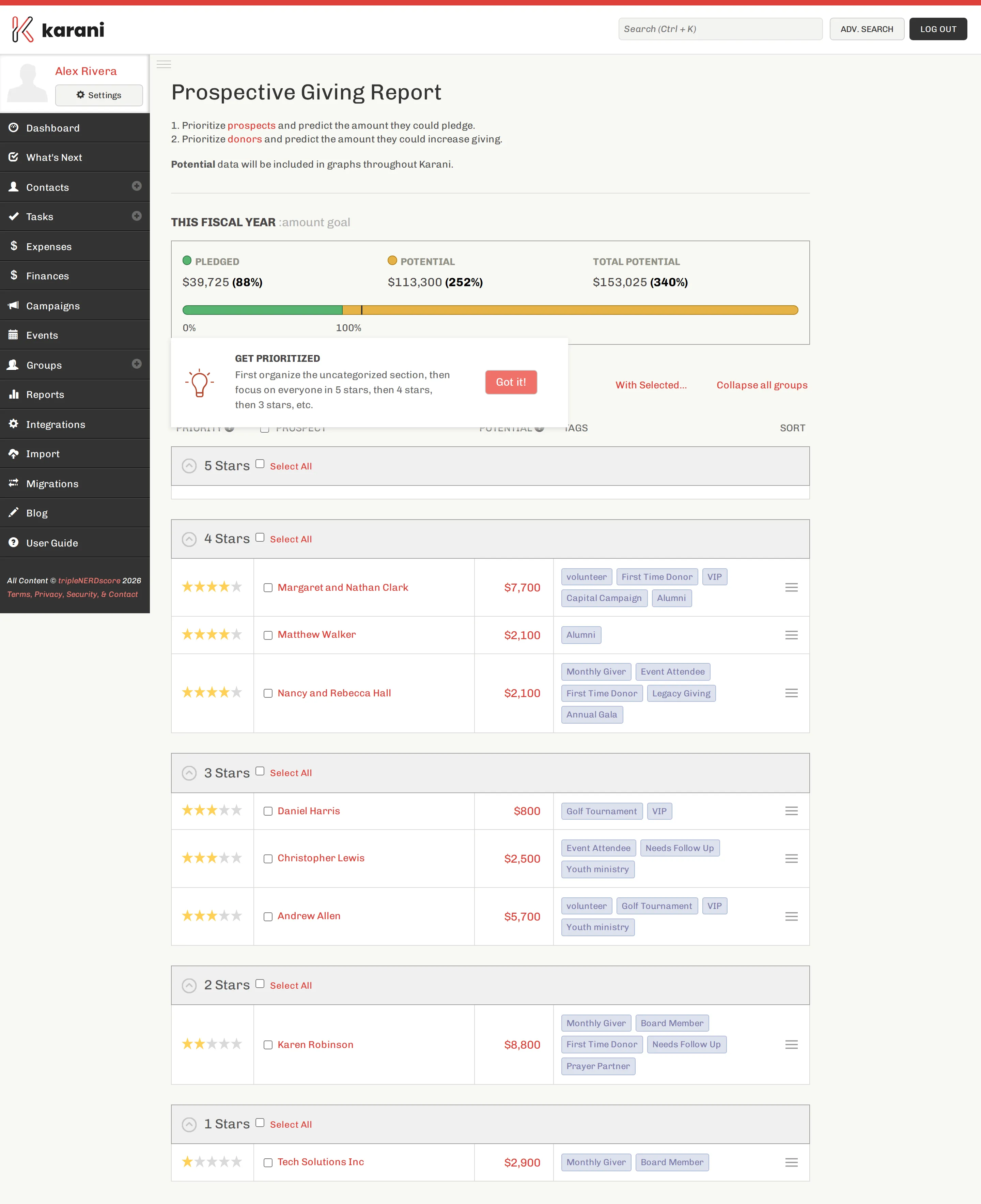
This report is where you record what you think each prospect might give, and see whether the pipeline is big enough.
Who appears
Section titled “Who appears”Contacts with a status of Prospect. Set that on the contact — see Contact statuses.
What you set
Section titled “What you set”For each prospect:
- Annual potential — what you realistically think they’d give in a year
- Rating — how you’d rank them
Where the numbers go
Section titled “Where the numbers go”Annual potentials feed the Potential figures on the Finances page and your dashboard. Karani shows:
- Pledged — money actually committed
- Potential — the sum of these estimates
- Total potential — both together
Setting honest potentials
Section titled “Setting honest potentials”The temptation is to make the numbers add up to your goal. Resist it — an inflated pipeline looks healthy right up until the year ends.
Better basis for an estimate:
- What they’ve given before, if they have.
- What comparable people give. Someone in a similar situation to your existing donors will probably land in a similar range.
- What you’re actually going to ask for. If you’re not going to ask for $5,000, don’t record $5,000.
A prospect you’re not really going to approach should be a Contact, not a Prospect.
Using the gap
Section titled “Using the gap”The useful calculation:
Left to raise (from Finances) versus total potential.
- Potential comfortably exceeds the gap → your job is working the pipeline.
- Potential roughly equals the gap → you need everyone to say yes, which they won’t. Find more prospects.
- Potential is below the gap → no amount of follow-up closes this. Prospecting is the work.
That’s a genuinely different diagnosis in each case, and it’s the main reason to keep this report current.
Cadence
Section titled “Cadence”Review quarterly, and properly at the start of each fiscal year. Prospects who gave become Donors; prospects who said no become Contacts; the rest need their potentials revisited.