

Welcome to Karani
Karani is a cloud-based CRM for anyone who fundraises as part of their job — not as all of it.
Most fundraising software is built for development departments: teams of full-time professionals with a database administrator down the hall. Karani was built from the ground up for the other people — missionaries, church planters, campus staff, program directors, artists, researchers — who have to raise their own support alongside the work they were actually called to do.
What “CRM” means here
Section titled “What “CRM” means here”CRM stands for Constituent Relationship Manager. Strip away the jargon and it means one thing: Karani keeps track of your relationships with the people who support your work, so you don’t have to hold it all in your head or in a spreadsheet that only you understand.
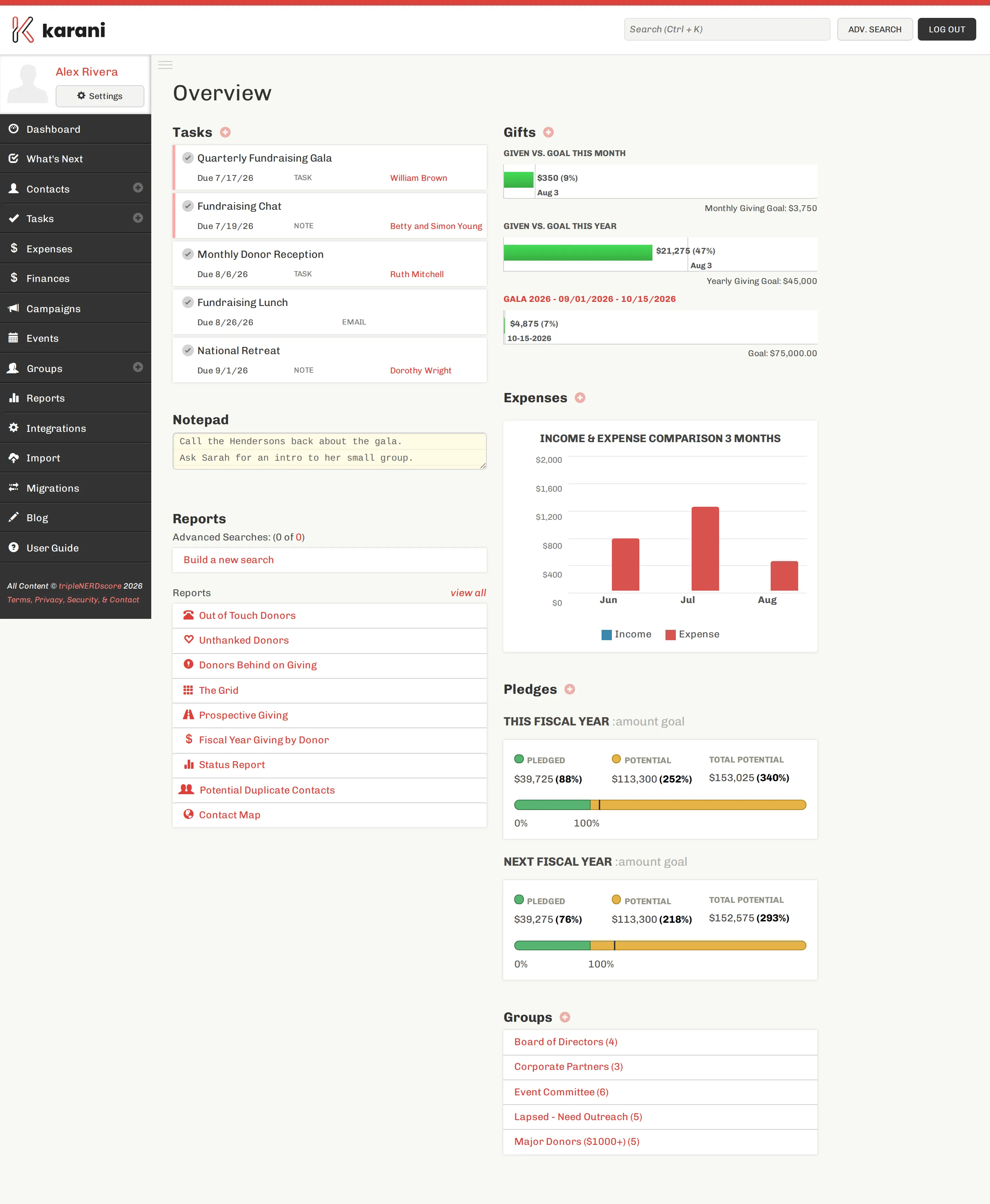
Concretely, Karani stores:
- Contacts — the people and organisations you’re in relationship with, whether they’re prospects, active donors, or lapsed.
- Tasks and interactions — what you need to do next with each person, and a permanent record of everything you’ve already done.
- Pledges and gifts — what people have committed to give, and what has actually arrived.
- Groups and tags — the ways you slice your list for newsletters, mailings, and bulk actions.
And then it does the arithmetic: how far you are from your goal, who’s behind on their pledge, who you haven’t thanked, who you haven’t spoken to in six months.
Who these docs are for
Section titled “Who these docs are for”Everything here describes Karani as an individual fundraiser or a small team uses it. If you’re an organisation administrator managing many staff accounts, your organisation has separate documentation — talk to whoever set up your Karani access.
How to use these docs
Section titled “How to use these docs”A note on the name
Section titled “A note on the name”Karani is a Swahili word for a clerk or a majordomo — as we see it, someone who takes care of everything for you. That’s the goal: bring some joy back into fundraising, make you effective and efficient at it, and then get out of your way so you can get back to the work.